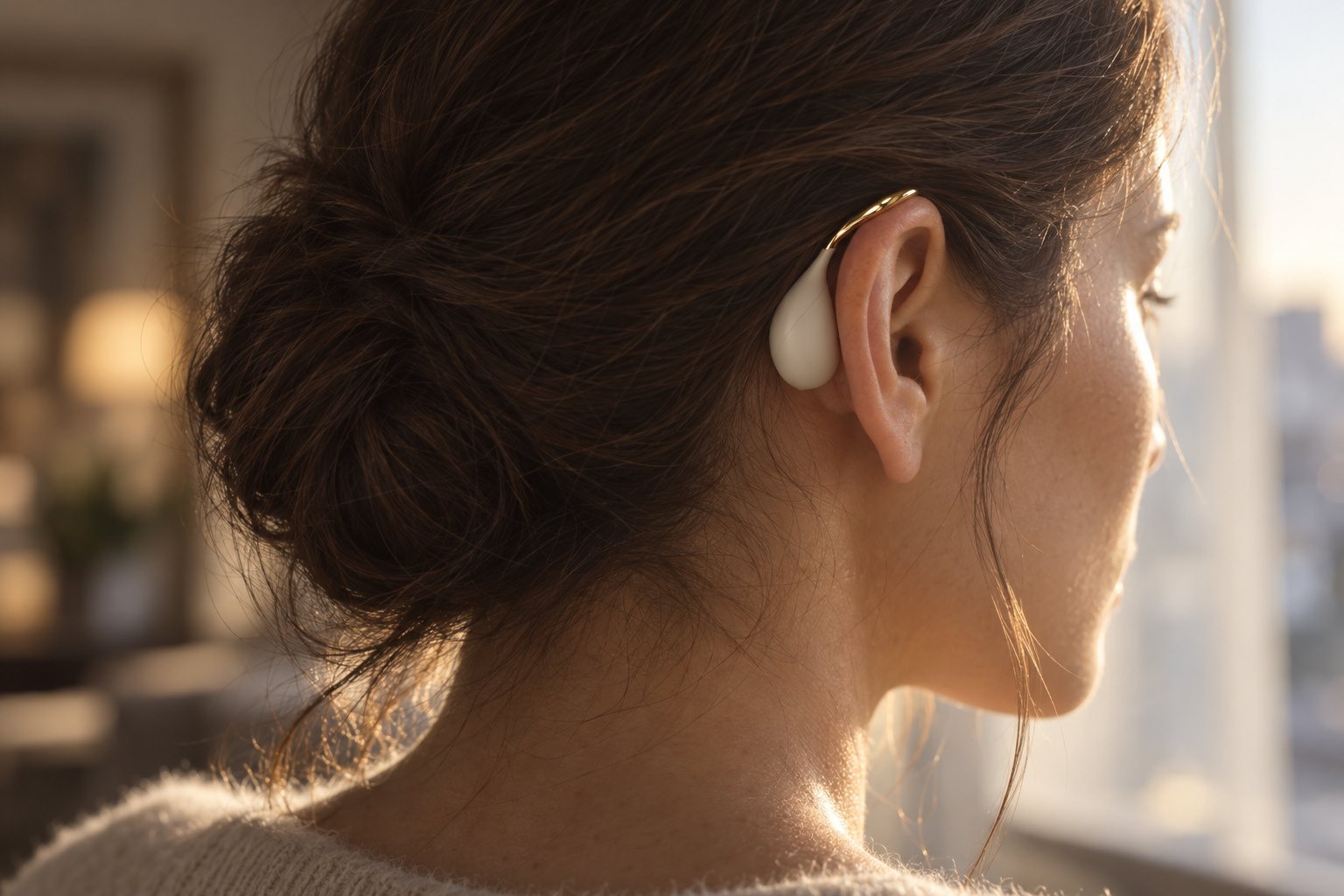
Let your jaw go.
About one in four adults tense their jaw during the day without knowing it. nou notices the moment it tightens, and helps you let go before it becomes a headache.
Free to join. Your data stays private.
About one in four adults tense their jaw during the day without knowing it. nou notices the moment it tightens, and helps you let go before it becomes a headache.
Free to join. Your data stays private.
Built on research published in
1 in 4
adults tense or grind their jaw during the day. Most never notice.
Journal of Clinical Medicine, 2024 ↗How it works
A small wearable senses the moment your jaw tightens, during the day and through the night.
A gentle tap reminds you to let go, quiet enough that it does not wake you at night.
Each morning, see when your jaw tightened, how your night went, and what made it calmer.
Sample screens. The device is still being designed.
Proven approach
Feedback timed to the jaw is not new. GrindCare, developed at Aarhus University in Denmark and sold through dentists by Sunstar, senses jaw muscle activity during sleep and answers it with a gentle signal. More than a decade of studies shows the jaw responds.
nou takes the same principle into everyday life: a gentle tap instead of an electrical pulse, during the day as well as at night, and a morning summary you can act on.
The trials so far are small, and they measured jaw muscle activity rather than pain, which did not change. Our early testers will help us learn what helps in daily life. GrindCare is a trademark of Sunstar. nou is not affiliated with Sunstar.
In a double-blind randomized trial with GrindCare, episodes per hour of sleep dropped by about half while the feedback was on.
Acta Odontologica Scandinavica, 2013 ↗In a second randomized pilot, jaw activity during sleep stayed 38% below where it started, in the recording taken after the treatment phase.
Oral Surgery, Oral Medicine, Oral Pathology and Oral Radiology, 2014 ↗In a full overnight sleep study, total sleep, deep sleep and brief awakenings were unchanged with the feedback switched on.
European Journal of Oral Sciences, 2011 ↗An international group of dentists and researchers agreed on guidelines for using this kind of feedback device in practice.
Journal of Oral Rehabilitation, 2019 ↗Two views of the same day.
Drag to compare. The same Thursday, felt and measured.
During the day
Daytime jaw tension is quiet. It builds on calls, in traffic and in long stretches of focus, and you only feel it hours later. People who tense their jaw during the day are 5 to 17 times more likely to have tension-type headaches.
See the research →Drag to compare. The same night, remembered and measured.
At night
Night grinding happens below awareness, so the first sign is often a sore jaw or a dentist's comment. A morning summary shows how your night went, and which evenings, drinks and late nights made it worse.
See the signs →Signs
These are the signals the research ties to jaw tension and grinding.
Daytime jaw tension is tied to 5 to 17 times higher odds of tension-type headaches.
J. of Oral & Facial Pain and Headache, 2021 ↗Half of people who grind weekly had real consequences: sore jaw muscles on waking, or dental work.
Chest, 2001 ↗A highly stressful life, anxiety, caffeine and heavy drinking each raised the odds of grinding at night.
Chest, 2001 ↗Across 37,680 people, about two thirds of those who grind also had a jaw joint disorder.
Dental and Medical Problems, 2025 ↗About half of string and wind players have a jaw disorder, and more daily playing time means more risk.
Journal of Oral Rehabilitation, 2021 ↗Research
Key references
nou is an early preview of a general wellness product. It surfaces patterns in jaw activity over time. It is not intended to diagnose, treat, cure, or prevent any disease. Talk to a dentist or doctor about any health concern.
Free to join. Four quick taps help us build the right thing.
Free to join. Your data stays private.